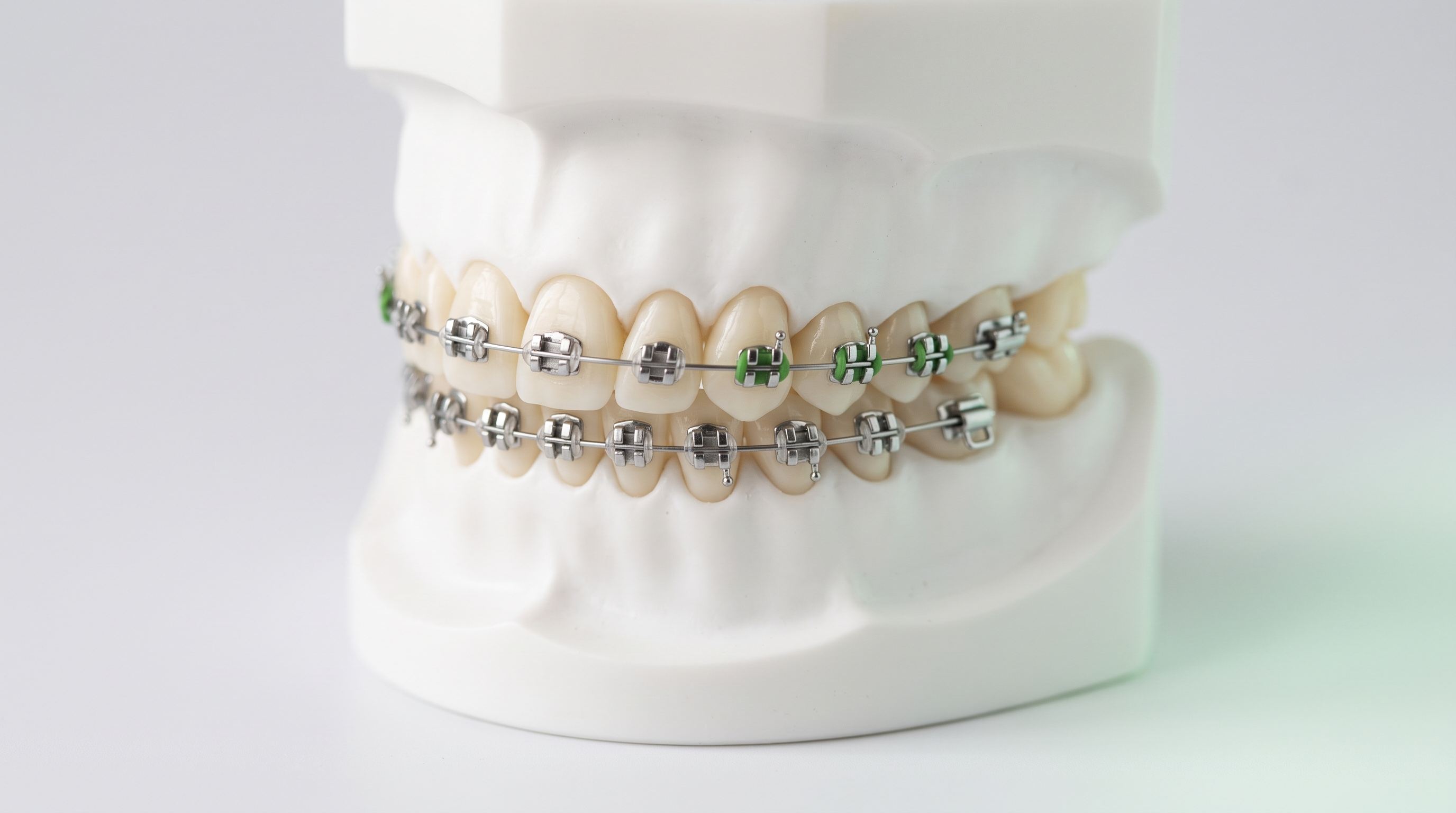
What are braces and how do they work?
Braces is the everyday name for fixed orthodontic treatment with brackets. Small brackets are bonded to the surfaces of the teeth and an orthodontic wire runs between them. The wire applies light, steady pressure to the teeth. In response, the bone around each tooth slowly remodels and the tooth moves towards its planned position.
During treatment the wires are changed or adjusted at set intervals. Where needed, extra parts such as elastics and springs may also be used. Because braces are fixed, the patient cannot take them out, so progress does not depend on remembering to wear an appliance every day.
Who are braces suitable for?
Braces can be considered for crowded teeth, gaps between the teeth, a deep bite or open bite, and a crossbite. They are widely used in children and teenagers once most of the permanent teeth have come through, and they can also be used for adults whose gums and bone are healthy. Our guide on orthodontics for adults explains more.
Any decay and gum problems need to be treated before treatment starts. Oral hygiene plays an important part in how treatment goes. Plaque builds up easily around the brackets, so without regular cleaning white spots and decay can form on the tooth surface.
What types of brackets are there?
| Bracket type | Appearance | General features |
|---|---|---|
| Metal brackets | On the front of the teeth, metal coloured | A durable option that has been widely used for many years |
| Aesthetic (ceramic) brackets | On the front of the teeth, close to tooth colour | Less noticeable; need careful looking after |
| Lingual brackets | On the inside of the teeth, not visible from outside | Fitting and getting used to them are different |
Metal brackets have long been the basic option for fixed braces. Which type of bracket suits you, and which options can be planned at the clinic, is decided at the examination. Our guides on ceramic braces and lingual braces describe these options in general terms.
What are the stages of treatment with braces?
- Orthodontic examination and records such as impressions or scans and X-rays
- Discussing the treatment plan, the options and the estimated length of treatment
- Treating any decay and gum problems
- Bonding the brackets to the teeth and placing the wire
- Changing and adjusting the wires at regular check-ups
- Removing the brackets and cleaning the teeth
- Fitting retainers and following them up
Bonding the brackets usually does not need an anaesthetic. In the first days after fitting, and after wire changes, the teeth may feel pressure and tenderness; in most patients this eases within a few days. The length of treatment depends on the type of problem; comprehensive treatment takes around one to two years in most patients.
Can I have braces if I live abroad?
Braces are different from treatments such as crowns or implants that can be completed in one or two trips. They stay on for many months, usually one to two years, and the wires need to be changed and adjusted at regular check-ups throughout. A bracket that comes off or a wire that breaks also needs to be seen without long delays. The British Orthodontic Society advises against starting treatment if you know you will not be able to keep your appointments.
Treatment with braces at our clinic therefore suits people who live in or near Sakarya, or who can come to the clinic regularly for check-ups. Whether a check-up schedule is realistic for you is discussed and planned at the examination, before treatment starts. If you live abroad and cannot attend regularly, an orthodontist near your home is the better choice. Our page on planning your visit shows which treatments can be completed in one or two trips.
How do you look after your teeth with braces?
- Brush your teeth after every meal, or at least twice a day, cleaning above and below the brackets separately.
- Interdental brushes and orthodontic floss help clean the areas under the wire.
- Hard foods such as nuts, ice and hard sweets, and sticky foods such as chewing gum and toffee, can make brackets come off.
- Eat hard fruit and vegetables such as apples and carrots in small pieces.
- If a bracket or wire is digging into your cheek, use orthodontic wax; let the clinic know about a broken or loose bracket.
- Have professional cleanings at the intervals your dentist recommends.
Taking care of your mouth throughout treatment helps keep the tooth surfaces healthy when the brackets come off. White spots that form around brackets can still be seen after treatment ends, so keep up careful cleaning from the very first day. Our guide on eating and cleaning with braces has more tips.
Why are retainers needed after treatment?
When the brackets come off, the teeth have not yet fully settled in their new positions, and the surrounding tissues can pull them back towards where they were. Retention is the stage that keeps the teeth in their new positions, and it is an essential part of treatment.
Two types of retainer are generally used. One is a thin fixed wire bonded to the back of the front teeth; the other is a clear removable retainer, worn especially at night. Which one is used, and for how long, is decided by the dentist. Not wearing retainers as advised can let the teeth shift again over time.
How does treatment with braces work at Rönesans?
Orthodontics is one of the treatment areas at Rönesans Diş Hekimliği in Serdivan, Sakarya. Before treatment starts, the teeth, jaws and bite are assessed at the examination, and any decay or gum problems are planned to be treated first. The impressions needed for planning can be taken with an intraoral scanner, without impression paste. Whether braces or another option such as clear aligners suits you is discussed with you after the examination, together with how often you would need to come for check-ups. Plaque can build up more around the brackets during treatment, so professional cleaning may be needed; the clinic also has a device that cleans the tooth surface with a spray of air, water and fine powder. The clinic is open 10:00–22:00 on weekdays and 10:00–19:00 on Saturdays, and you can communicate with us in English or German. The cost is confirmed after the examination, according to the treatment plan.