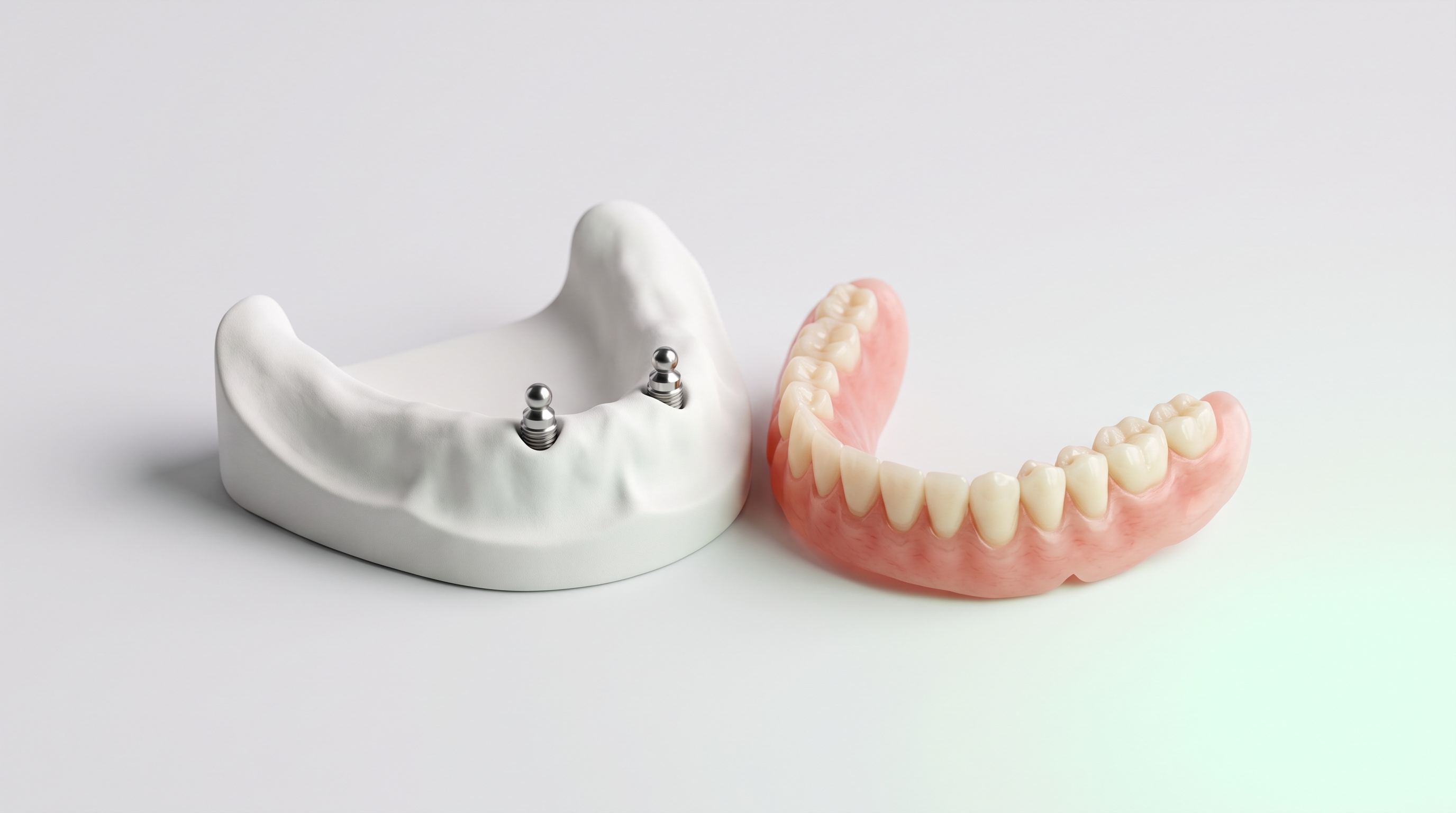
What is an implant-supported denture?
An implant replaces the root of a lost tooth; the visible, chewing part is the prosthesis fixed on top of it. Between implant and prosthesis there is usually a connecting piece called an abutment. Depending on how many teeth are missing, the prosthesis is planned as a single crown, a bridge or a restoration for the whole jaw.
For an edentulous jaw there are two basic forms: a fixed bridge that is screwed onto the implants and removed only by the dentist, and a removable denture (overdenture) that clips onto the implants and is taken out daily for cleaning.
Fixed or removable: what is the difference?
| Feature | Fixed on implants | Removable on implants |
|---|---|---|
| Taken out | No; by the dentist when needed | Daily, for cleaning |
| Implants in an edentulous jaw | Usually more | Usually fewer |
| Cleaning | In the mouth with interdental brushes, water flosser | Outside the mouth; implants cleaned separately |
| Palate in the upper jaw | Left free | Partly covered, depending on design |
| Feel | Close to natural teeth | Much more stable than a conventional denture |
The table shows general tendencies; which type suits you needs a personal assessment.
What fixed options are there?
- Crown on an implant: replaces a single tooth without preparing the neighbouring teeth.
- Bridge on implants: several missing teeth are replaced with fewer implants than teeth.
- Fixed full-arch bridge: in an edentulous jaw, a group of implants carries a one-piece bridge. See our page on full-arch implants.
A fixed prosthesis is either screw-retained or cemented. Screw-retained work can be removed and refitted at the clinic; with cemented work the screw access is invisible, but removal is harder. According to the 2013 ITI consensus statement, both methods perform similarly in clinical studies but differ in the complications they tend to cause. The material is chosen according to aesthetics, chewing forces and the opposing jaw.
How does a removable denture stay on the implants?
A removable implant-supported denture looks similar to a conventional complete denture but clips onto the implants through attachments. Common systems are individual stud or ball attachments on each implant, a bar connecting the implants, or telescopic crowns. A 2018 Cochrane review could not show that any system is superior; the trials were small and the evidence of very low quality. Repairs of the attachment were more frequent with ball attachments than with bars, while replacement rates did not differ.
The 2009 York Consensus Statement recommends a denture on two implants as the first-choice treatment for an edentulous lower jaw; according to the German dental association KZBV, two to four implants in the lower jaw, or four to six in the upper jaw, are enough to give a denture firm support. The plastic inserts in the attachments wear and are renewed from time to time; a dentist at home can in principle do this if they know the system.
How does treatment work and how many trips does it take?
- Examination, cone-beam CT (CBCT) and a written treatment and cost plan
- First trip: implant placement, after extractions where needed; depending on your case, a temporary prosthesis for the healing period
- Healing at home, several months for most patients
- Second trip: check of healing, uncovering the implants and fitting healing caps, impressions
- Choosing tooth shade, shape and bite; try-in
- Fitting the prosthesis and adjusting the bite
- Check before you leave, later check-ups at home
Allow several appointments on the second trip, because the prosthesis is tried in and adjusted. How many days this takes depends on the type of prosthesis and is set after the examination. Our guide on how many days you need in Türkiye for dental implants gives a general picture, and the page on planning your visit describes how a trip is organised.
How do you care for the prosthesis?
- Brush a fixed prosthesis twice a day and clean under the bridge with interdental brushes, implant-friendly floss or a water flosser.
- Take a removable denture out every day for cleaning, and brush the attachments on the implants separately.
- The gum around implants is more sensitive than around natural teeth; home care and professional check-ups matter especially here.
- Tell your dentist if you grind or clench your teeth; a protective night guard may be recommended.
- Report looseness, fracture, a loose screw or bleeding gums around an implant without waiting for your next appointment, either to a dentist at home or to us on WhatsApp.
Read more in our guide on caring for teeth on implants and on the aftercare and follow-up page.
How does treatment work at Rönesans?
Implantology and prosthodontics are among the treatment areas at Rönesans Diş Hekimliği in Serdivan, Sakarya, east of Istanbul. The position of the implants and the surrounding bone are assessed with the cone-beam CT (CBCT) at the clinic. The make and model of your implants are written in the written treatment and cost plan, and the details of each implant on the implant card you receive after treatment. Impressions for the prosthesis can be taken with an intraoral scanner without impression material; some removable dentures need a conventional impression. Crowns and dentures are made with CAD/CAM at the dental laboratory we work with. You can communicate with us in English, German or Turkish; for a preliminary assessment, send photos and existing X-rays on WhatsApp to +90 532 363 49 54. The transfer from the Istanbul airports and accommodation in Sapanca are included in the treatment price, and when you leave you receive a summary of your treatment and copies of your X-rays. Our treatments come with a guarantee under set conditions for problems not caused by the patient; we explain its duration and scope before treatment begins.