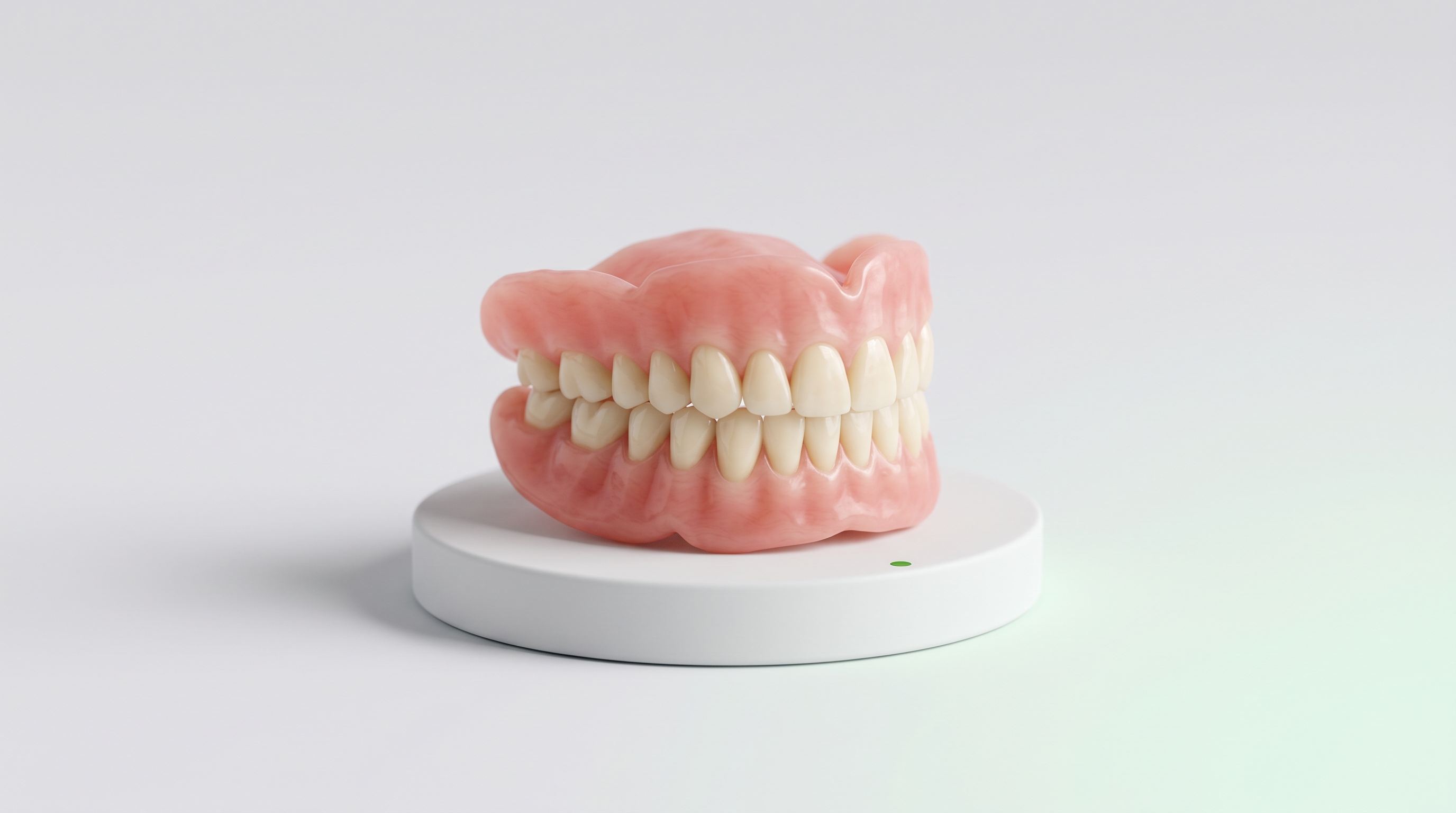
What is a denture?
A denture, or dental prosthesis, replaces missing teeth. Missing teeth affect more than appearance: chewing and speech become harder, neighbouring teeth can tilt into the gap and teeth in the opposite jaw can grow into it.
There are two main groups: fixed prostheses that stay in the mouth (crowns, bridges, crowns on implants) and removable dentures that you take out yourself (complete and partial dentures). Both groups can be supported by natural teeth or by implants.
Fixed or removable: what is the difference?
| Feature | Fixed prosthesis | Removable denture |
|---|---|---|
| Examples | Crown, bridge, crown on an implant | Complete denture, partial denture, implant-retained denture |
| Taken out | No | Daily, for cleaning |
| Support | Natural teeth or implants | Gums, palate, remaining teeth or implants |
| Neighbouring teeth | Abutment teeth are prepared for a bridge | Clasps can load the remaining teeth |
| Cleaning | In the mouth with brush, floss, interdental brush | Outside the mouth |
Removable partial dentures are used when too few teeth remain to anchor a bridge. Which group suits you depends on how many teeth are missing, the condition of the remaining teeth and gums, and the amount of bone.
What do complete and partial dentures mean?
A complete denture replaces all the teeth in one jaw. It stays in place by suction, with the palate helping in the upper jaw. In the lower jaw, retention is often harder because the tongue and cheeks move the denture. The York Consensus Statement of 2009 therefore recommends a denture on two implants as the first-choice treatment for an edentulous lower jaw. According to the German dental association KZBV, two to four implants in the lower jaw, or four to six in the upper jaw, are enough to give a denture firm support. See our page on implant-supported dentures.
A partial denture is used when some natural teeth remain. It is held by clasps or by precision attachments on the remaining teeth. Clasp dentures need little tooth preparation, but the clasps can be visible and put load on the remaining teeth; telescopic or precision-attachment dentures hold more firmly without visible clasps, but the abutment teeth need more preparation.
How is a denture made and how many visits does it take?
- Examination, X-rays and a written treatment and cost plan
- Preparatory treatment: gum treatment, fillings, root canal treatment and, where needed, extractions
- For fixed prostheses, preparation of the abutment teeth
- Impressions, digital or with impression material
- Choosing tooth shade, shape and bite; try-in appointments
- Fitting and adjustment in the mouth
- Check-ups while you get used to the denture
The number of visits depends on the type of denture. Removable dentures are usually checked at several try-in appointments before they are finished. If teeth have to be extracted, there is another factor: the jaw changes shape while the socket heals. According to the NHS, an immediate denture can be made within a few days, but often needs adjusting or replacing up to a year later. Whether you receive the final denture in one trip, or whether two trips make more sense, is decided after the examination; see also planning your visit.
How do you get used to a new denture?
A new denture, especially a removable one, feels strange at first. More saliva, difficulty with some sounds and an unsteady feeling when chewing are common in the first days. For most people these settle down.
Do not grind or bend the denture yourself to relieve a sore spot; the adjustment belongs in a dental practice, here or at home. Because gums and jawbone change over time, the fit can loosen; the denture may then need to be adjusted or relined.
How do you care for a denture?
- Rinse removable dentures after meals and clean them twice a day with a denture brush.
- Clean them over a basin of water so they do not break if dropped.
- Do not use hot water, which can change the shape.
- Clean your gums, remaining teeth and any implants every day as well.
- Keep regular check-ups, including with your dentist at home, so the fit can be checked.
- The NHS advises removing dentures at night unless your dentist tells you otherwise.
What does this mean for treatment in Türkiye?
Check with your insurer at home whether any part of the cost can be reimbursed and which paperwork they need, before treatment starts. Our page on dental treatment in Turkey explains how a visit is organised.
Before treatment begins, you receive a written treatment and cost plan. When you leave, you receive a summary of your treatment and copies of your X-rays, so a dentist at home can carry out check-ups and minor adjustments. After you return, you can reach us on WhatsApp; see our page on aftercare and follow-up.
How does treatment work at Rönesans?
Prosthodontics is one of the treatment areas at Rönesans Diş Hekimliği, a dental clinic in Serdivan, Sakarya, east of Istanbul. For a preliminary assessment, send photos and existing X-rays on WhatsApp to +90 532 363 49 54; you can communicate with us in English, German or Turkish. If an implant-retained denture is being considered, the bone is assessed with the cone-beam CT (CBCT) at the clinic. In suitable cases, impressions are taken with an intraoral scanner without impression material; for some removable dentures a conventional impression is preferred. Crowns and dentures are made with CAD/CAM at the dental laboratory we work with. The transfer from the Istanbul airports and accommodation in Sapanca are included in the treatment price. The type of denture and the cost are set out in the written treatment and cost plan after the examination. Our treatments come with a guarantee under set conditions for problems not caused by the patient; we explain its duration and scope before treatment begins.